- Home
- Budget,Brand and Buying
- Test Capacity
- Buy Bigger Now or Expand Later
Buy Bigger Now or Expand Later? When
Expansion Batteries Make Financial Sense (Cost Test)
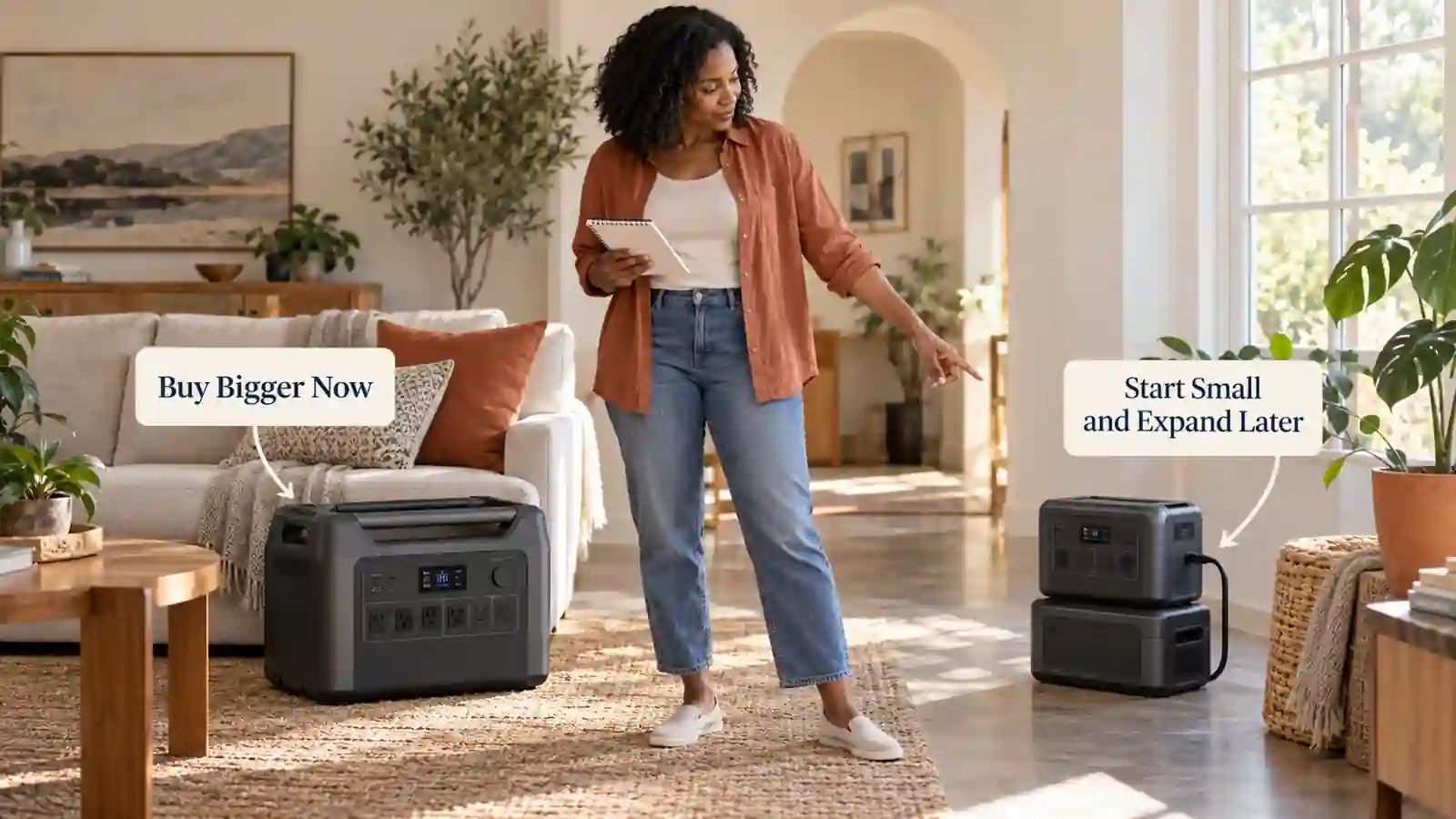 Compare the full cost and your likely future needs before choosing a larger system or an expandable starter unit.
When I bought my first portable power station, my biggest question was simple: what size should I buy now, and should I expand later? In this guide, I will show you the cost test I use and a quick example from my own choice.
Before we talk about cost, one mistake can ruin the whole decision: capacity is not the same as output. Output is the power the inverter can deliver, measured in watts. Continuous watts run an appliance. Surge watts start it. An expansion battery mainly adds stored energy and longer runtime. It does not automatically increase the base station’s continuous or surge power.
Starting small makes sense when the base power station can cover your essential loads—such as laptops, a router, phones, lights, or a fan—and you are not yet sure what you will need later. It also helps if a compatible battery is likely to stay available.
Start Small or Buy Bigger
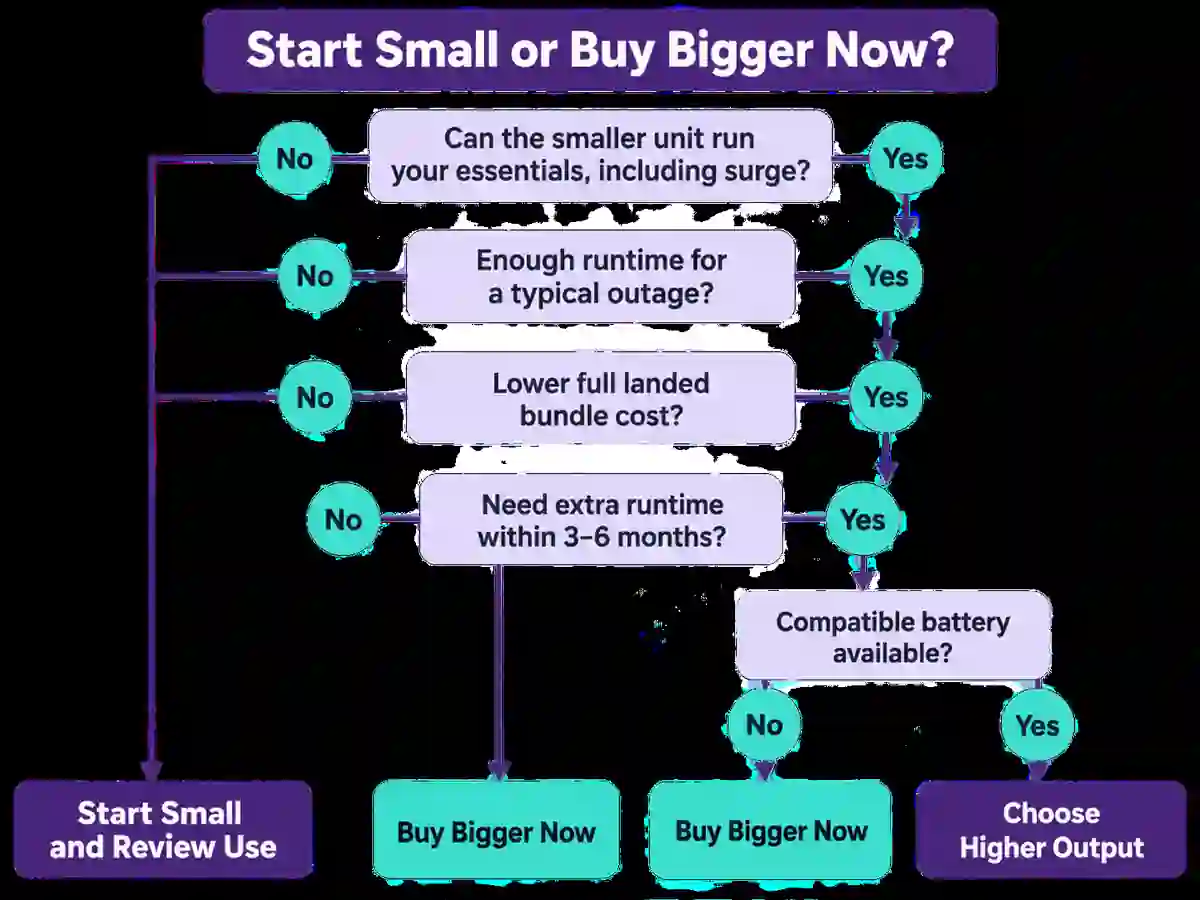
Start small and expand later if
• The base station can cover your essentials during a typical outage or work block—for example, one workday for a router and laptop.
• You are not sure which loads you may add later, so buying extra capacity now could waste money.
• Expansion batteries are available for that model family in your market.
Buy bigger now if
• You expect to need the extra runtime within the next three to six months.
• The larger bundle costs less after you compare the full landed cost of buying once instead of in two steps.
• Later expansion could cost much more because of availability, shipping, or price changes.
Not sure how much capacity your essential appliances need? Use our Budgeting vs Capacity Trade-Off guide to work out what you need for a typical outage or work block before you choose.
COUNT THE FULL COST
Compare Added Usable Capacity
Do not compare only the larger unit’s price with the expansion battery’s listed price. Work out what each option costs for the extra energy you can really use.
Below is the simple formula I use when I am unsure. It helps me compare what I need with the cost of expanding.
Cost per added usable Wh = (battery price + delivery + accessories) ÷ (added rated Wh × usable percentage)
Usable percentage is the share of rated Wh you are likely to get in real use.
If you do not know the usable percentage, choose one careful estimate—for example, 80%—and use the same number for both options. This keeps the comparison fair.
Worked example: If a battery costs $400 and adds 1,000Wh, an 80% estimate gives you 800 usable Wh. If delivery and accessories add $80, the total cost is ($400 + $80) ÷ 800, or $0.60 per added usable Wh.
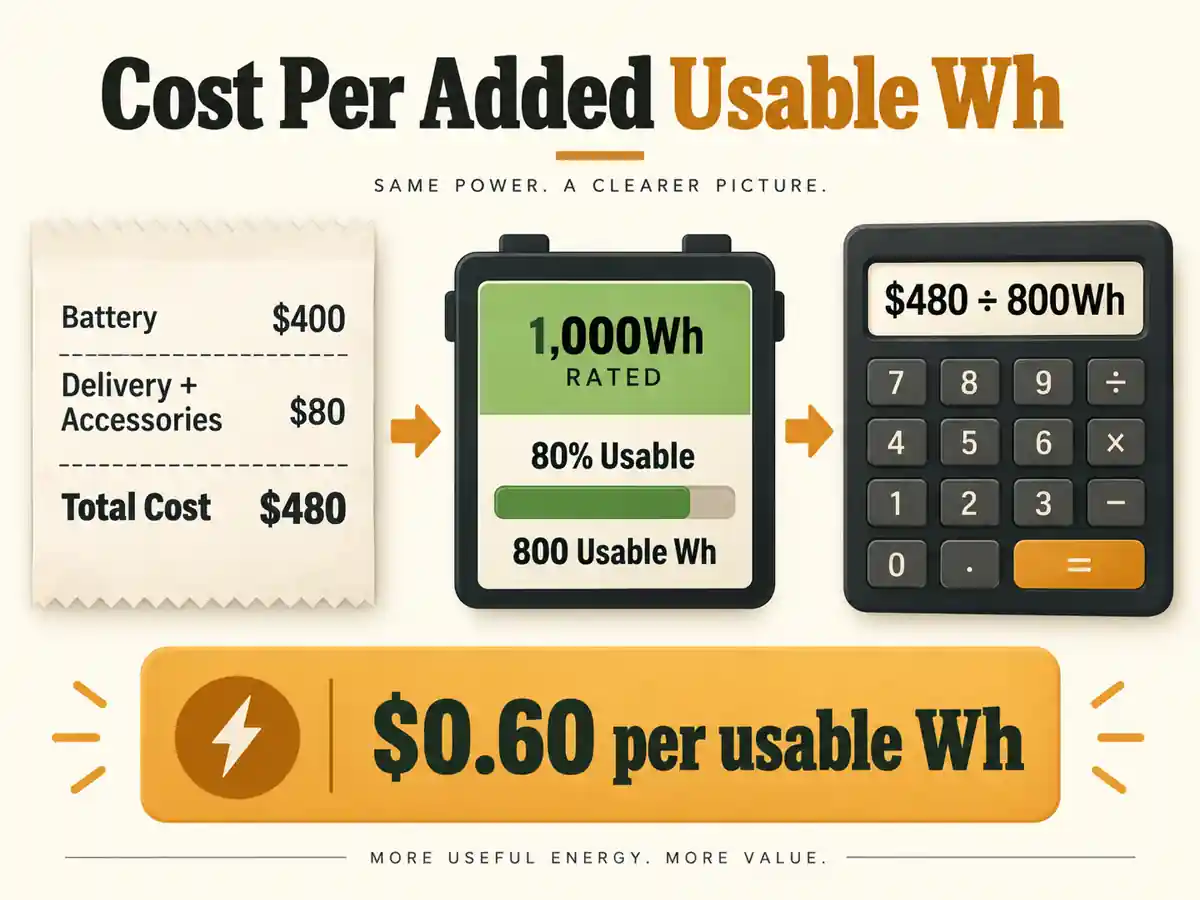 Compare expansion choices by cost per usable watt-hour, not by the advertised battery price alone.
Add Landed Cost
Wherever you live, compare the landed cost—the total cost to your door. In Nigeria, for example, that may include currency conversion, international delivery, import costs, and local transport.
That happened to my friend when he moved from 700Wh to 1200Wh. He thought it would cost only $300, but delivery and accessory costs added another $70. He ended up paying $370. That is why you compare landed cost, not just the sticker price.
START SMALL WHEN UNCERTAIN
Let Actual Use Reveal Shortages
Starting small makes sense when the base station can handle your essential appliances’ running and surge power and gives you enough energy for normal outages or trips.
Use the unit during two real outages or two evenings. Track router hours, laptop hours, phone charging, and anything else you wish you could run.
If the base unit is enough, you keep cash for better upgrades such as faster charging, better solar input, or safer cables. That makes starting small a smart money choice, not just a way to manage uncertainty.
Example: Why I started with 1000Wh. I saw that it could cover my essentials—my laptops, phone, and router—as a remote worker.
In my case, the fridge could wait, along with other heavy-duty appliances. But if you must run a fridge, you are more likely to need the “buy bigger now” option or a different setup.
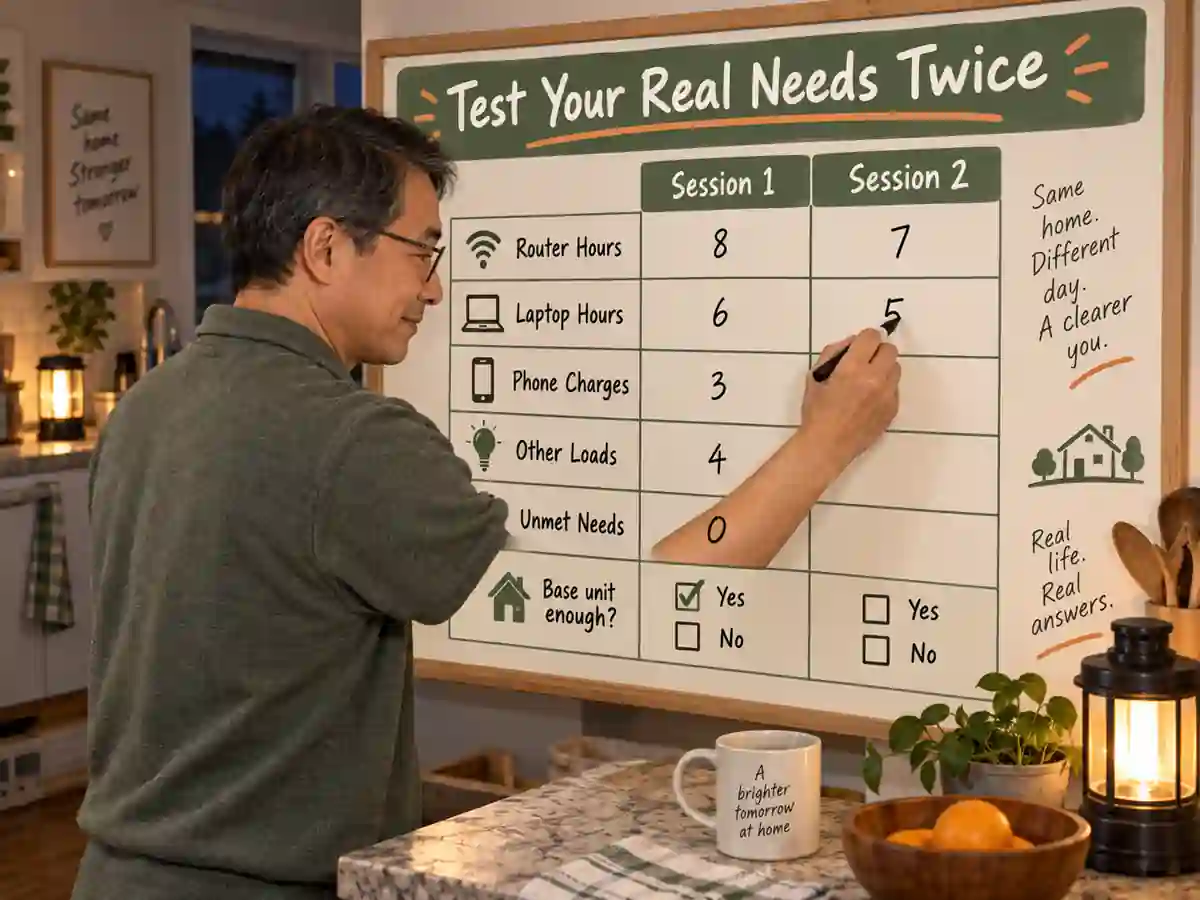 Track two realistic use periods before paying for more capacity
BUY BIGGER WHEN CERTAIN
Use a Genuine Bundle Saving
Buying bigger now usually makes sense when you know you will use the extra capacity often. But the saving must be clear. Count it as real only if it saves you one full round of shipping or import costs, or if the landed total is clearly lower than buying in two steps.
Reduce Availability Risk
Buying now can reduce availability risk because expansion batteries are often made for specific product families.
However, do not buy years of unused capacity. Instead, choose a product family with batteries sold in your region and a history of supporting older models.
When I carried out an energy audit at Mr. Sunny Audo’s house to see what solar generator capacity would suit him, he chose the bigger option. He needed the extra capacity soon, and the bundle discount reduced the landed cost.
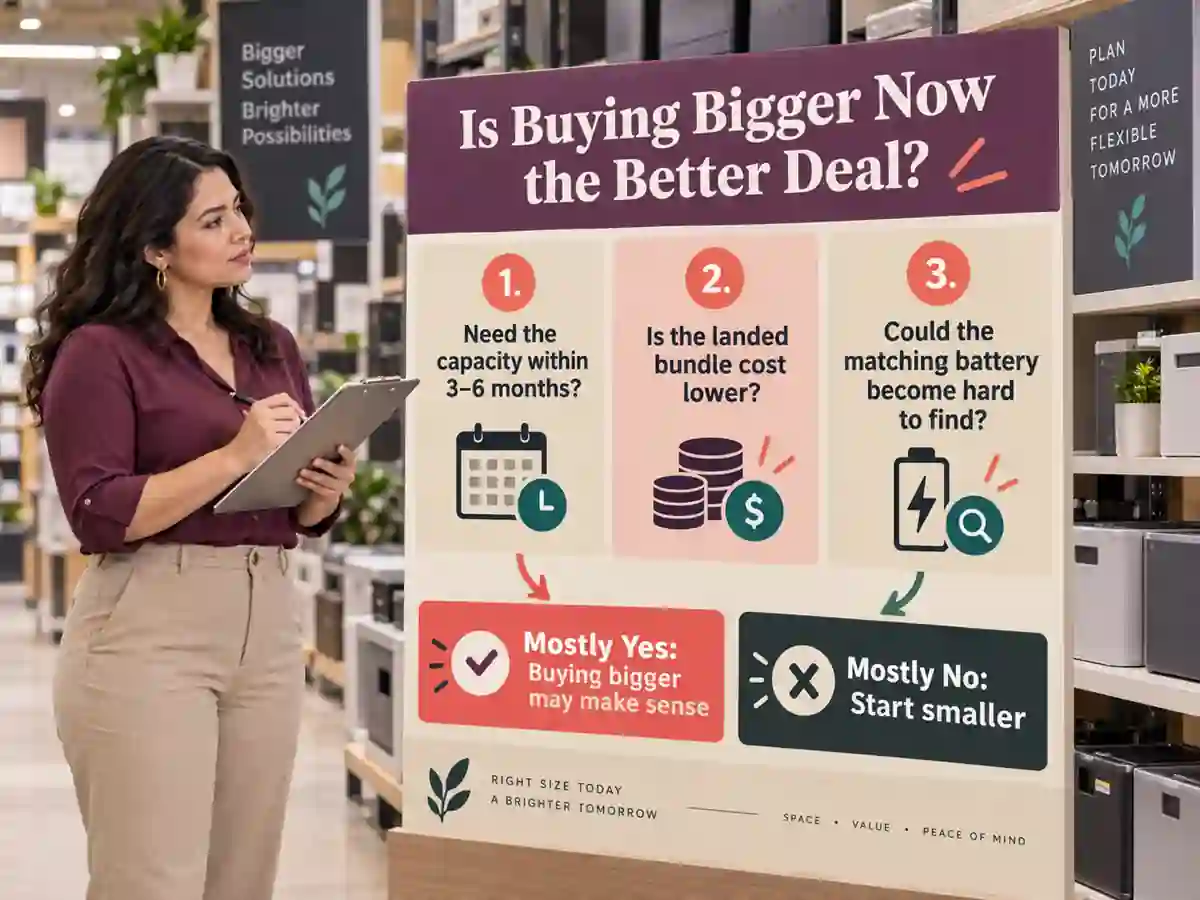 A bundle saving is useful only when you need the capacity and the full delivered cost is lower
CHECK WHAT EXPANSION CHANGES
Compare a Second Power Station
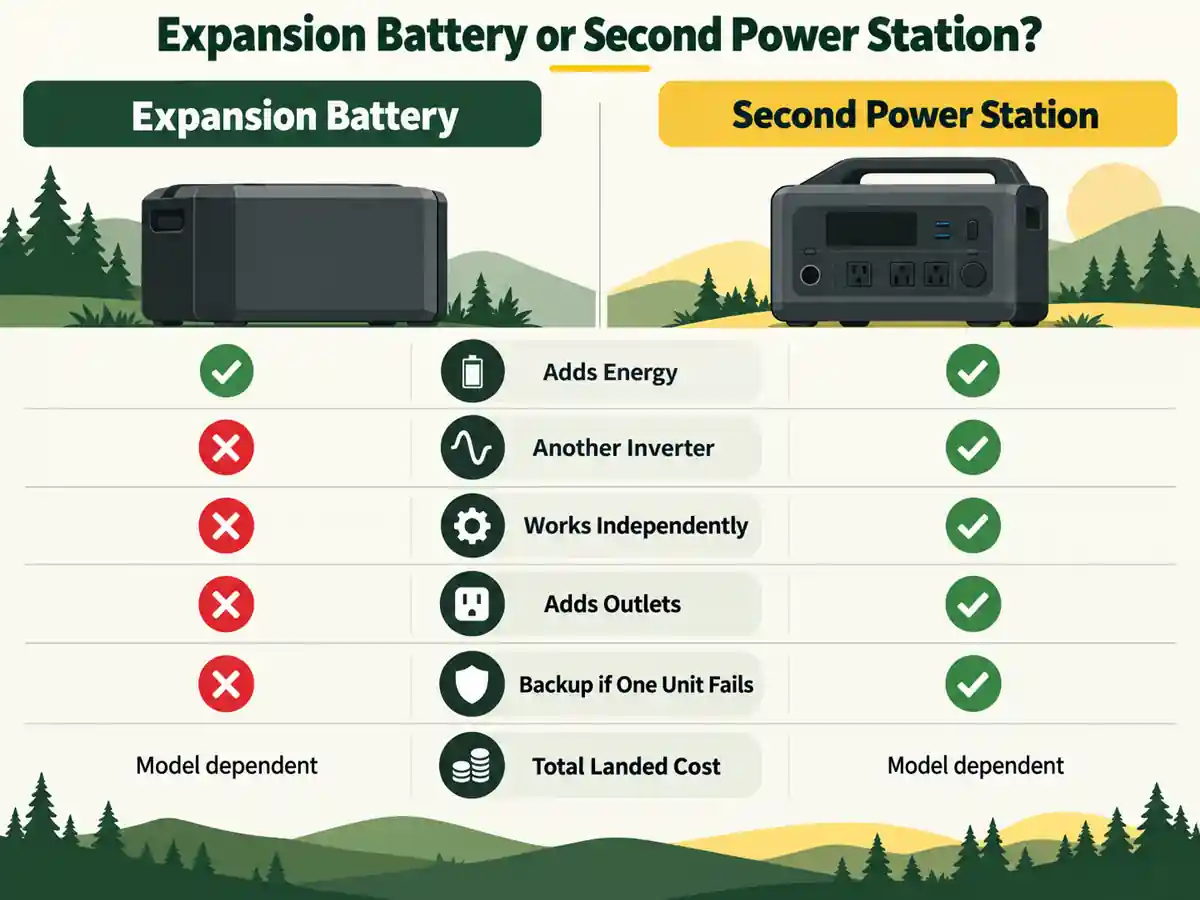
Also compare an expansion battery with a second complete power station. The second unit may give you another inverter, independent use, more outlets, portability, and backup if one station fails. Some expansion batteries cannot work on their own.
Use this checklist when comparing the two options:
• Total landed cost
• Continuous watts and surge watts
• Portability
• Number and type of outlets
• Redundancy if one unit fails
• Ability to operate independently
MAKE THE FINAL CHOICE
Before you choose, make sure you can answer these questions:
1. Can the smaller unit run your essentials at both continuous and surge wattage?
2. Does it give you enough energy for a typical outage or work block?
3. Is later expansion really cheaper after delivery, accessories, and other landed costs?
4. Are compatible expansion batteries available in your market?
5. Will you need the extra runtime within the next three to six months?
In summary, start small when the smaller station meets your needs now and you are not sure what you will need later. Buy bigger now when you will need more capacity soon and the full upfront cost is lower or carries less availability risk
 Use output, runtime, landed cost and timing—not battery size alone—to make the final choice
CHOOSE YOUR NEXT STEP
Now that you know which option fits your needs, continue with the path that matches your choice:
Start small and expand later: See the best expandable power stations for growing backup needs. It includes a shortlist of expandable families, the batteries available locally, and practical starter sizes.
Buy bigger now: See the best high-capacity portable power stations for buying bigger upfront. It includes a shortlist of larger systems, minimum output targets, and bundle prices that stay cheaper after landed cost.
 Use output, runtime, landed cost and timing—not battery size alone—to make the final choice.
About The Author
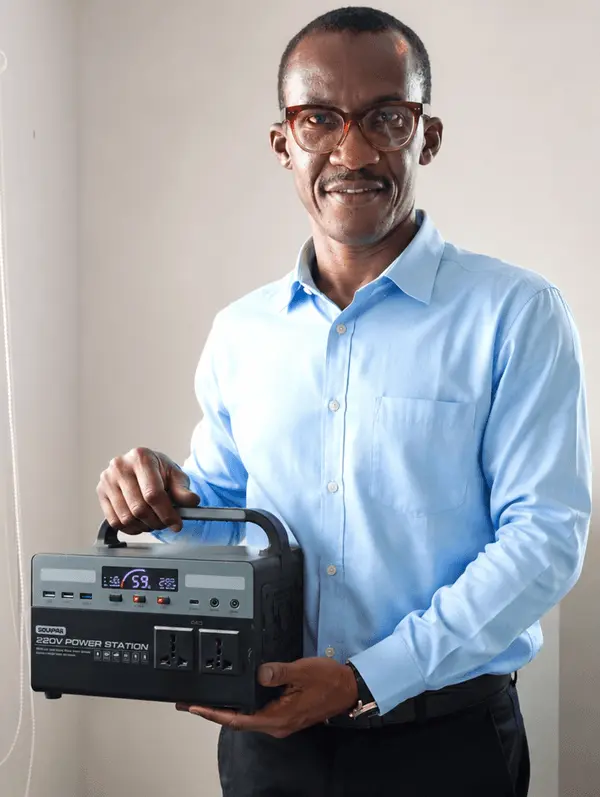
I'm Kaycee. I created Power With Confidence to help you make sense of portable power stations without feeling overwhelmed by technical jargon or pushed into overspending. After spending 3 years using portable power solutions in various situations, my goal is to share practical, honest guidance that helps you buy with more clarity and confidence.
Portable Power Station Runtime Calculator
Build your household load list and estimate how long a battery may power it.
Household Appliance Loads
| Appliance | Appliance Watts | Appliance Quantity | Hours Per Day | Daily Energy Consumption (Wh) | Remove |
|---|
Battery Runtime Calculator
Estimate only. Appliance cycling, starting demand, temperature, battery age and the power station’s own consumption can change real runtime.

Explore The Web
THIS CONNECTS ONE LINK
THIS IS THE RELATED PAGES
TO THE SALES PAGE