- Home
- Budget,Brand and Buying
- Test Capacity

Budgeting vs Capacity Trade-Off: Start With Your Must-Run
A smart portable power station purchase starts with your must-run appliances, not the biggest battery you can afford. First define the minimum capacity that covers your essential devices, then decide whether extra runtime, convenience, or future use is worth the added cost.
This helps you avoid both underspending on a unit that will disappoint and overspending on capacity you may never use.
A useful budget begins with a job description. Decide what must stay powered, for how long, and under what conditions before looking at battery sizes or sale prices.
The aim is not to buy the most capacity. It is to find the smallest sensible system that handles your essentials reliably, with enough margin for real-world losses and normal changes in use.
START WITH ESSENTIAL APPLIANCES
Maximum capacity sounds reassuring, but it is not a useful target by itself. Your target should be the minimum sensible capacity for the work you actually need done. That keeps the budget tied to a clear outcome rather than a fear of running out.
From experience
A careful buyer once combined emergency backup, camping comfort and “just in case” anxiety into one list. It included a fridge, television, microwave, coffee maker, fan, laptop, lights and several camping extras. The resulting unit was expensive and too heavy to move comfortably. Once the list was divided into essentials and optional comforts, the realistic requirement became much smaller and easier to afford.
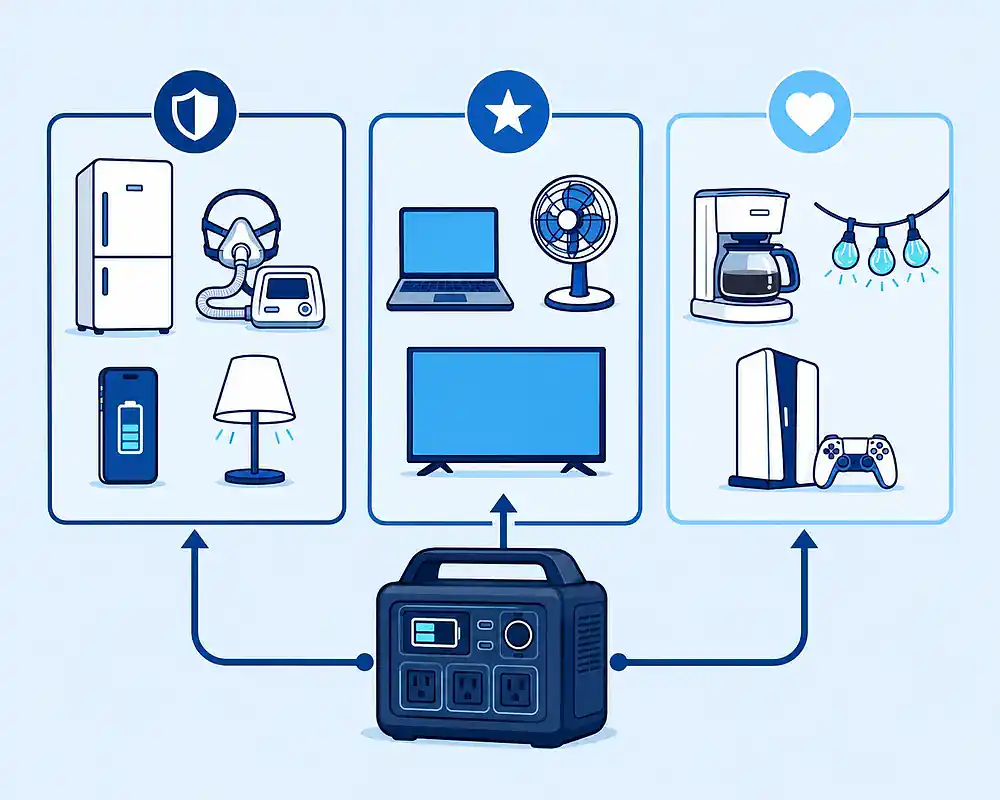 Most buyers get better results by defining must-run appliances before comparing bigger battery sizes.
Define your non-negotiable appliances first
Write down must-run devices that protect safety, communication, food, health or essential work. A phone, router, medical device, selected lights and perhaps refrigeration may belong here. Record each device’s running watts and the number of hours you truly need it.
Do not assume every device must run continuously. A fridge cycles on and off. Phones charge for a limited time. A router may need overnight power, while a laptop can be charged once and used from its own battery.
Separate must-run backup from comfort extras
Create three groups: must-run, helpful and optional. A fan in hot weather may be essential for one household and simply helpful for another. A television, coffee maker or decorative lighting may be pleasant, but it should not quietly dictate a much larger battery unless you knowingly accept the cost
Why fear-based shopping leads to overspending
Fear encourages buyers to prepare for every possible event at once. That often means paying for energy that sits unused, extra output that no planned appliance needs, and weight that makes the station less practical. Plan first for your most likely use, then identify one or two upgrades that would genuinely improve resilience.
Key Takeaway
Your essential list—not a promotional capacity number—should set the starting budget.
FIND A SENSIBLE CAPACITY
Capacity is measured in watt-hours, written as Wh. In simple terms, a 100-watt device running for three hours needs about 300Wh before allowing for power losses. Add the energy needs of each essential device to create your first target.
Estimate what your essentials actually need
List each device, its watts and intended runtime. Multiply watts by hours. If a router uses 12 watts for ten hours, that is 120Wh. Add a 10-watt light for five hours, or 50Wh, and two 60Wh laptop charges. Your rough requirement becomes 290Wh before losses and reserve.

Add a reasonable buffer without panic-buying
Add a measured buffer of roughly 15 to 25 percent for conversion loss, changing device draw and a modest reserve. This is a planning allowance, not a promise of exact runtime. If an appliance is safety-critical, plan more conservatively and confirm performance through reliable testing.
A buffer should cover normal uncertainty. It should not become a second full battery added purely for comfort. If your estimate is 600Wh, a target around 750Wh may be sensible; automatically jumping to 2,000Wh needs a specific reason.
JUDGE USABLE POWER
The number printed on a battery describes rated storage, not usable energy. It does not mean every watt-hour reaches your appliance. The inverter, cooling system, internal electronics and battery protection all use or retain some energy.
Rated watt-hours are not usable energy
A station rated at 1,000Wh may provide noticeably less through its AC sockets. The exact result depends on inverter efficiency, operating load, temperature and the manufacturer’s reserve. Independent discharge tests are therefore more valuable than simply comparing printed numbers.
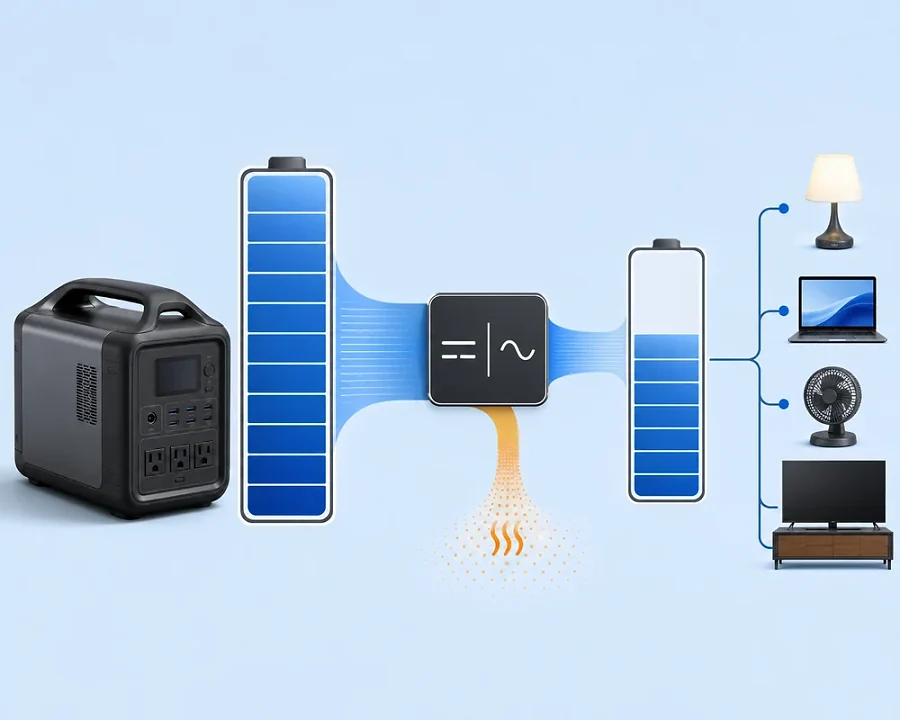 The printed battery number is not always the same as the usable energy a buyer gets in real conditions.
How losses affect runtime
Small AC loads can be less efficient because the inverter remains active. High loads drain the battery quickly and may create more heat. Cold conditions can also reduce available performance. For phones and other USB devices, direct DC or USB charging can sometimes avoid part of the AC conversion loss.
PAY FOR USEFUL UPGRADES
A larger unit is worthwhile when it changes the result: it runs an essential appliance the smaller model cannot, lasts through the required period, recharges in time, or supports a realistic future need.
When extra capacity is worth paying for
Suppose a smaller model covers lights, phones and internet for one evening, while the next size also keeps refrigeration running safely overnight. That upgrade changes the outcome and may justify the added price. If both sizes perform the same essential job, the larger battery may only buy unused reassurance.
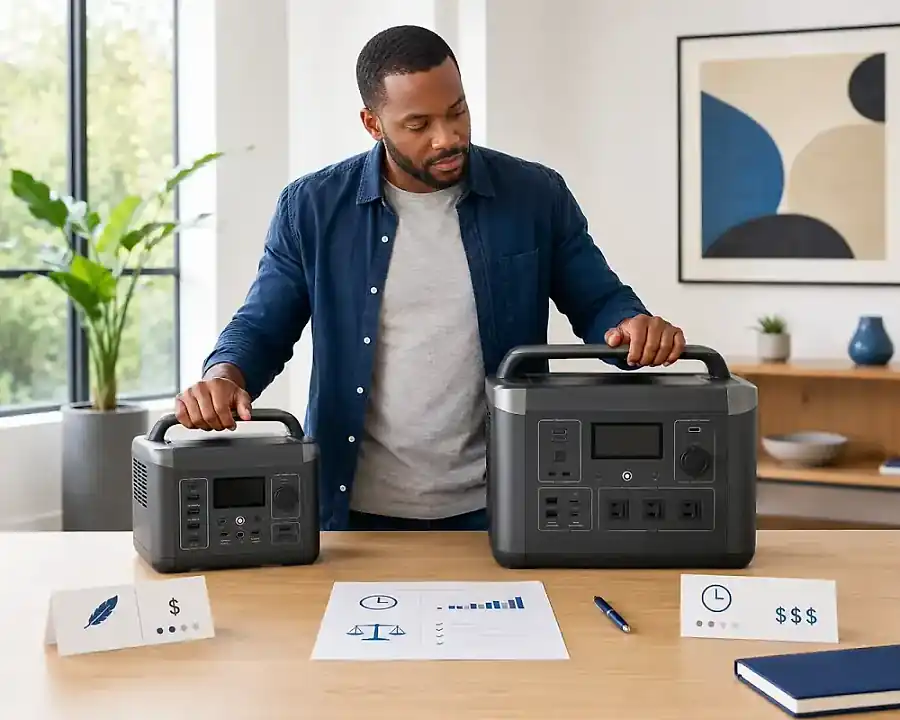 Paying more only makes sense when the larger unit changes what the buyer can actually run or how long they can run it.
When output matters more than battery size
A large battery with a weak inverter may still fail to start a fridge, pump or tool. Compare continuous output first, then surge performance, and read whether surge mode reduces voltage in a way your appliance may dislike. Never buy on peak wattage alone.
When speed or portability changes the decision
Fast recharge matters when grid power returns briefly or you reuse the station daily. Lower weight matters when the unit moves between rooms, campsites or work vehicles. Expandable batteries can support future growth, but only if the system cost, compatibility and storage make sense. Pay for convenience you will repeatedly use.
JUDGE LONG-TERM VALUE
Full ownership value includes dependable performance, manageable weight, suitable charging, battery longevity, repair options and support that responds when something goes wrong.
Why the cheapest option can cost more later
A low purchase price loses its appeal when charging takes too long, the unit is frustrating to move, replacement cables are unavailable or support disappears. A product used often should make the routine easier, not create a new problem every time power goes out.
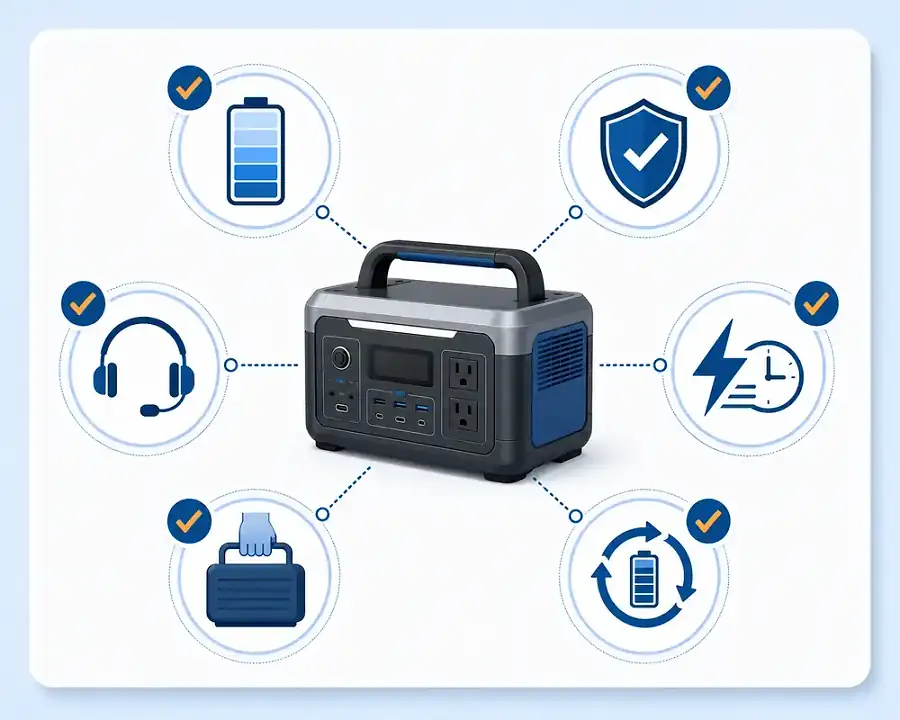 Real value comes from the full ownership picture, not just a low price or a big battery number.
Check warranty and support before buying
Read what the warranty covers, how long battery coverage lasts, who pays return shipping and whether service is available in your country. Send support a question before purchase. A useful, specific reply provides better evidence than a long warranty headline with unclear exclusions.
I use this useful capacity and warranty information help in checking the essential things before you make your decision
Everyday usability matters
Check battery chemistry, cycle-life wording, charging options, fan noise, display clarity, port layout and storage needs. A durable battery is valuable only if the station remains convenient enough to use. Follow sensible storage and charging practices so the capacity you buy stays useful.
PUT YOUR RANGE TO WORK
Once you know your appliances, runtime and budget ceiling, move from broad research to a narrow range. That is the point where comparison becomes faster and less emotional
Test fuzzy needs in the calculator
Enter each must-run appliance and expected runtime into the portable power station calculator. Test a base case first, then add one comfort item at a time. You will see which additions meaningfully change your capacity band.Calculate my power needs →
Portable Power Station Runtime Calculator
Build your household load list and estimate how long a battery may power it.
Household Appliance Loads
| Appliance | Appliance Watts | Appliance Quantity | Hours Per Day | Daily Energy Consumption (Wh) | Remove |
|---|
Battery Runtime Calculator
Estimate only. Appliance cycling, starting demand, temperature, battery age and the power station’s own consumption can change real runtime.
Compare models in your range
When your range is clear, compare only models that meet it. Check usable energy, continuous output, recharge time, weight, warranty and final price using the same standard for every product. Ignore models that require hopeful assumptions.
Make the final decision
Ask three questions: Does it run every essential device? Does it cover the target time with a sensible reserve? Does it stay within the highest price you can pay comfortably? If all three answers are clear, you are ready to compare sellers and warranty terms.
A buyer is ready to move on when the essential devices, target runtime and budget ceiling are written down. If one is still vague, more product browsing usually adds confusion rather than confidence. Get your correct checklist from our email newsletter.
FREQUENTLY ASKED QUESTIONS
Is it better to buy extra capacity now or upgrade later?
Is it better to buy extra capacity now or upgrade later?
Buy extra now only when the added runtime solves a likely need. If the system supports well-priced expansion and your future requirement is uncertain, upgrading later can protect today’s budget.
How much buffer should I add?
How much buffer should I add?
About 15 to 25 percent is a practical starting allowance for conversion losses and normal variation. Critical loads or difficult conditions may justify more careful planning.
Does a larger battery always mean better value?
Does a larger battery always mean better value?
No. Value improves only when the extra energy changes runtime or capability in a way you will use. Otherwise, it adds price, weight and storage needs
What matters more: capacity or output
What matters more: capacity or output
Both matter, but output is the first gate for demanding appliances. A battery cannot help if its inverter cannot safely start or run the device.
Am I paying for utility or peace of mind?
Am I paying for utility or peace of mind?
Name the exact situation the upgrade solves. If you cannot connect it to a device, runtime or recharge need, you may be buying reassurance rather than practical utility.
When does portability matter more than size?
When does portability matter more than size?
Portability matters when the station regularly moves between rooms, vehicles, campsites or work areas. A smaller unit you can position easily may serve you better than unused capacity you avoid lifting.
Is a cheaper station worthwhile for occasional backup?
Is a cheaper station worthwhile for occasional backup?
Yes, if it safely meets your essential load, comes from a supportable seller and has acceptable usable capacity. Occasional use does not make unclear safety or misleading claims acceptable.
About The Author

I'm Kaycee. I created Power With Confidence to help you make sense of portable power stations without feeling overwhelmed by technical jargon or pushed into overspending. After spending 3 years using portable power solutions in various situations, my goal is to share practical, honest guidance that helps you buy with more clarity and confidence.

Explore The Web
THIS CONNECTS ONE LINK
THIS IS THE RELATED PAGES
TO THE SALES PAGE